Artificial Intelligence is increasingly shaping how organizations approach Environmental, Health, Safety, and Sustainability (EHS&S) management. What was considered a leading-edge or experimental capability just a few years ago has become more widely accessible. In the 2019 NAEM survey, only 5% of respondents reported that their company used AI tools—today, that number is 94%. This change is prompting EHS&S leaders to evaluate how AI fits within regulated, risk-sensitive environments.
Sponsored by: 3E, Benchmark Gensuite, Cority, Haven, VelocityEHS
Letter from the Executive Director
Artificial intelligence is on everyone's mind. It's not the first technology to promise transformation within the EHS and Sustainability function, nor will it be the last. Over the past decade, NAEM research has consistently shown that technology adoption follows a familiar path, early experimentation by a small group of organizations, followed by broader awareness, uneven uptake, and then a lengthy period of integration as companies work through questions of governance, data readiness, and value.
What is different today is the accessibility of AI. Capabilities that were once cutting edge, experimental, and used by only a limited number of organizations have, in a relatively short period of time, become widely available to EHS&S professionals at all levels. As a result, AI is no longer viewed solely as a future state innovation. Instead, it is increasingly part of day-to-day work, supporting how EHS and Sustainability teams research information, create content, and manage growing workloads.
This report reflects the perspectives of EHS&S professionals across a wide range of industries, organization sizes, and risk profiles. Together, their responses provide a timely benchmark of how AI is being used today, where organizations are gaining traction, and where adoption remains constrained. As with past NAEM research on emerging technologies and leading edge practices, the findings reveal meaningful progress alongside important variability in maturity.
The purpose of this research is not to predict where AI will ultimately lead, nor to prescribe a single path forward. Rather, it is to provide EHS&S leaders with a clear view of how their peers are navigating the current landscape, the questions they are confronting, and the considerations shaping responsible use. By grounding the discussion in real world experience and peer benchmarking, this report is intended to support informed decision-making and productive conversation within organizations.
We encourage EHS and Sustainability leaders to use this research as a reference point, whether to validate current approaches, inform discussions with internal stakeholders, or assess readiness for more advanced applications. As with any emerging capability, the long term impact of AI in EHS&S will be shaped less by the technology itself and more by how thoughtfully it is integrated into existing systems, processes, and leadership practices.
Sincerely,
Carol Singer Neuvelt Executive Director, NAEM
About NAEM
The National Association for Environmental, Health and Safety, and Sustainability (EHS&S) Management (NAEM) empowers corporate leaders to advance environmental stewardship, create safe and healthy workplaces and promote global sustainability. As the leading professional society for EHS & Sustainability decision makers, NAEM creates curated learning events, conducts research, and facilitates high-value peer networking. All with a goal to create a community and effective resources for solving today's corporate EHS&S management challenges. Visit online at naem.org.
Executive Summary
Artificial Intelligence is increasingly shaping how organizations approach Environmental, Health, Safety, and Sustainability (EHS&S) management. What was considered a leading-edge or experimental capability just a few years ago has become more widely accessible. In the 2019 NAEM survey, only 5% of respondents reported that their company used AI tools, today, that number is 94%. This change is prompting EHS&S leaders to evaluate how AI fits within regulated, risk-sensitive environments.
This report provides a data-driven examination of the current state of AI adoption within EHS and Sustainability functions. Drawing on survey data from EHS&S professionals across a broad range of industries, organization sizes, and risk profiles. The research explores how AI is being used today, the value organizations are realizing, and the barriers that continue to limit more advanced application.
Survey results indicate that most organizations are applying AI in practical, productivity-focused ways, often driven by individual initiative rather than formal strategy. At the same time, respondents highlight persistent challenges related to governance, data quality, system integration, and organizational readiness. These themes mirror patterns NAEM has observed with prior waves of EHS&S technology adoption: value often appears first at the individual level, while scale and integration require deliberate leadership and sustained investment.
While the practices highlighted in this report do not represent the experiences of all organizations, they reflect the real-world conditions under which EHS&S teams are experimenting with, adopting, and governing AI. Meanwhile, EHS leaders are taking proactive steps to advance more sophisticated AI adoption, by focusing on research, training, and partnerships, respondents are setting themselves up for success in addressing the top challenges to adoption identified in this study.
Consistent with NAEM's prior research on emerging technologies and leading-edge practices, this report is intended to help EHS&S leaders better understand where their organizations stand relative to peers and identify the considerations shaping responsible use.
Research Approach – Overview
This report provides a data-driven examination of the current state of AI adoption within EHS and Sustainability functions based on quantitative survey data and qualitative interviews.
The survey was designed to capture both foundational and more advanced uses of AI, ranging from individual productivity tools to applications embedded within formal EHS and Sustainability workflows. In addition, respondents were asked to identify drivers of adoption, barriers to scale, and steps their organizations are taking to prepare for broader AI use.
The findings reflect the input from 109 different companies. Survey respondents represent companies from a cross-section of industries, geographic footprints, and EHS risk profiles, providing insight into adoption patterns across diverse operational contexts.
Using data from that survey, NAEM then conducted in-depth interviews with 12 EHS&S AI experts to better understand:
- How AI is being applied in practice to support EHS and Sustainability activities
- The organizational, governance, and data considerations influencing adoption decisions
- The challenges organizations encounter as they move beyond early experimentation
The qualitative insights drawn from these interviews are integrated throughout the report to provide context and perspective alongside the quantitative findings. All survey responses and interview contributions have been anonymized.
The analysis and conclusions presented in this report were independently developed by NAEM.
Demographics
Industry
Survey respondents represent a broad cross-section of industries, with strong participation from manufacturing, utilities, pharmaceuticals, transportation, and other regulated sectors.
Figure 1 — Respondent's Primary Industry Sector
- Other Manufacturing: 11%
- Pharmaceutical & Medical Devices Manufacturing: 6%
- Diversified Manufacturing: 6%
- Utilities: 5%
- Transportation & Warehousing: 5%
- Electronics Manufacturing: 4%
- Chemical Manufacturing: 4%
- Aerospace Manufacturing: 4%
- Services: 4%
- Biotechnology: 3%
- Other: 3%
- Multi-industry Company: 3%
- Retail & Wholesale Trade: 2%
- Mining (Oil & gas, minerals, coal, etc.): 2%
- Information: 2%
- Financial Services: 2%
- Construction: 2%
- Technology: 1%
- Industrial Machinery Manufacturing: 1%
- Consumer Product Manufacturing: 1%
- Automotive Manufacturing: 1%
- Extractive & wood/paper/pulp Manufacturing: 1%
Annual Revenue
The survey primarily reflects large, multi-facility organizations, suggesting EHS&S programs operating at scale.
Figure 2 — Respondent's Annual Revenue
- More than 1 Billion USD, Less than 10 Billion USD: 35%
- More than 10 Billion USD, Less than 25 Billion USD: 20%
- More than 50 Billion USD: 14%
- More than 25 Billion USD, Less than 50 Billion USD: 12%
- Less than 250 Million USD: 11%
- More than 250 Million USD, Less than 1 Billion USD: 9%
EHS Risk Profile
Respondents span the full range of EHS risk profiles, from lower-risk environments to high-risk industrial operations.
Figure 3 — Degree of EHS Risk Relative to Corporations in Other Industry Sectors
- Medium degree of EHS Risk: 54%
- High degree of EHS Risk: 23%
- Low degree of EHS Risk: 23%
The State of AI in EHS&S
Top Applications of AI in EHS&S Today
Respondents report that AI use in EHS&S is concentrated in a small set of practical, productivity-oriented applications. The most common uses include searching for and synthesizing information, drafting or editing policies, procedures, and training materials, and summarizing regulatory requirements or guidance. These applications reflect AI's primary role today as a support tool for information management and content creation rather than as an integrated or decision-support capability.
Figure 4 — Top 10 Ways Respondents Use AI
- Using Generative AI to search for information: 94%
- Using Generative AI tools to summarize regulations, guidance, documents, or reports: 81%
- Using Generative AI to analyze data for key points/takeaways: 72%
- Using Generative AI tools to draft policies, procedures, or training materials: 65%
- Using Generative AI to check accuracy of information: 55%
- Using AI that is integrated into our software solution(s): 48%
- Using Generative AI tools to transpose information from documents into forms or templates: 44%
- Extracting data from PDFs, permits, SDSs, or reports: 42%
- Using Generative AI tools to brainstorm sustainability initiatives: 33%
- Basic chatbots for internal EHS Q&A: 25%
On the Cutting Edge
In discussing the results, an NAEM Research Committee member and Sustainability leader commented:
"The vast majority of respondents are still in the early stages of the AI journey and that's great, we are all in it together. But it's also clear that there is a leading edge of respondents that can show us the way forward."
Figure 5 — Bottom 10 Ways Respondents Use AI
- AI-driven prioritization of inspections and audits: 5%
- Autonomous hazard identification and alerts: 5%
- Predictive models for environmental incidents or permit exceedances: 5%
- Computer vision for PPE compliance: 5%
- Automated compliance monitoring across jurisdictions: 4%
- Real-time risk sensing using IoT + AI: 4%
- Computer vision for unsafe behaviors or conditions: 3%
- Scenario modeling for sustainability strategies: 3%
- AI-supported regulatory submissions (with controls): 1%
- Scaled Scope 3 emissions estimation and supplier risk screening: 1%
Limited Adoption of Advanced AI Capabilities
Respondents report very limited use of AI for advanced, highly integrated applications. The least common uses include scaled Scope 3 emissions estimation, AI-supported regulatory submissions, real-time risk sensing, and autonomous hazard identification, each cited by only a small share of organizations. These results indicate that AI applications requiring enterprise-wide integration, formal governance, or direct influence on regulated decision-making remain uncommon relative to more basic or productivity-oriented use cases.
While organizations have embraced AI for practical productivity gains, movement into decision-support and enterprise-scale use remains limited.
AI Maturity
To assess how organizations are using artificial intelligence in EHS and Sustainability, this research organizes AI activities into seven levels of maturity. Levels are defined by how AI is applied, how formal its use is, and how deeply it is integrated into EHS&S systems and decision-making. The framework is intended to provide a common language for understanding AI maturity and to help EHS&S leaders contextualize their organization's current state relative to peers.
Survey responses show that 94% of respondents participated in at least one Level One activity, while only 5% of respondents participated in at least one Level Seven activity. Respondents could select multiple AI activities within each level, but this chart displays only the most commonly chosen activity. Progression through these levels reflects increasing organizational confidence, governance, and operational integration, not simply the use of more advanced technology. Movement across the maturity levels is not linear or inevitable, and many organizations operate at multiple levels simultaneously across different functions or use cases.
Figure 6 — AI Maturity Levels
- Level 1, Background research only: 94%
- Level 2, Basic content creation: 81%
- Level 3, Early/Task Automation: 42%
- Level 4, Operational/Embedded in Workflows: 19%
- Level 5, Advanced/Decision-Support: 12%
- Level 6, Scaled & Governed: 9%
- Level 7, Innovative: 5%
Level 1 — Background Research AI is used informally by individuals for general research or editing. Use is occasional, unofficial, and not connected to internal EHS or sustainability data or workflows.
Level 2 — Basic Content Creation AI supports drafting documents or summarizing information related to EHS&S topics. Use remains individual and informal, with no integration into systems or core processes.
Level 3 — Early/Task Automation AI is applied to automate discrete, low-risk EHS or sustainability tasks. Use begins to extend beyond individual experimentation and starts to support core processes on a limited basis.
Level 4 — Operational/Embedded in Workflows AI is formally integrated into EHS or sustainability systems and team-based workflows. Use is intentional, repeatable, and part of regular operations.
Level 5 — Advanced/Decision-support AI outputs actively inform decisions by helping prioritize actions, allocate resources, or assess risk. Human ownership remains, but AI materially influences outcomes.
Level 6 — Scaled & Governed AI is trusted for regulated, enterprise-wide use. Formal governance, controls, and accountability mechanisms are in place to manage risk and ensure compliance.
Level 7 — Innovative AI is treated as a strategic capability rather than a tool. Applications support proactive, adaptive risk management through real-time sensing, automation, and continuous learning.
Applying AI Where It Improves Safety Outcomes
Perspective from Natasha Porter, Chief Operating Officer, Benchmark Gensuite
Natasha Porter cautions that the greatest risk in AI adoption for EHS&S is not the technology itself, but how it is applied in real world environments. "My biggest concern is not the technology itself; it's how it gets applied in real EHS&S environments," she explained. Too often, AI is positioned as a source of insight without a clear connection to the decisions and workflows that actually improve safety. "In EHS&S, insight alone is not the goal. The goal is better prevention, earlier visibility to meaningful risk, and faster action where it matters most."
Porter also emphasized that generic application of AI poses particular challenges in a highly contextual domain. EHS&S risk is shaped by the work being performed, the environment, the controls in place, and the quality of the underlying data. "EHS&S is not one size fits all," she noted. "If AI is not grounded in that context, it can miss what is important, overstate what is not, and ultimately erode trust with the very professionals who need to rely on it."
Finally, Porter stressed the importance of maintaining professional judgment in safety critical settings. While AI can enhance visibility and speed, it should not replace accountability or expertise. "We must be careful not to position AI as a substitute for professional judgment," she said. "The best use of AI is to strengthen human capability, not bypass it." In EHS&S, she underscored, credibility, context, and accountability remain essential. "AI should help experienced professionals see around corners faster, while leaving room for the expertise, judgment, and leadership that this field requires."
Five Actionable AI Case Studies in EHS&S
AI Application 1: AI-Assisted Incident Documentation and Quality Review
Maturity Level: Level 3, Early/Task Automation
Implementation Tactics
- Used AI to draft incident descriptions from initial notes and photos
- Generated diagrams or visual reconstructions from text and images
- Ran completed reports through AI quality checks before final submission
- Maintained clear separation between AI drafts and approved records
Peer Perspectives
"AI does an excellent job evaluating the quality of an incident report and recommending improvements to strengthen the documentation."
"We used AI to generate a diagram from a brief description and a photo, which made the incident much clearer."
AI Application Challenge
"Inaccuracies are not always obvious, and the time required to validate AI generated content can offset some efficiency gains."
AI Application 2: Policy, Procedure, and Training Content Development
Maturity Level: Level 2, Basic Content Creation
Implementation Tactics
- Used gen AI tools to draft first versions of policies and SOPs
- Prompted AI with regulatory language or internal standards
- Relied on EHS professionals to review, correct, and approve all content
- Did not integrate AI into document control systems
Peer Perspectives
"Generative AI can generate policy documents in a fraction of the time it used to take."
"It gave us a detailed template that we could then refine."
AI Application Challenge
"The research is not always accurate when applying regulatory references to our specific processes."
Domain Expertise Ensures Quality
Perspective from Maria Rutland, Senior Vice President for GTM, 3E
There's a saying in computer science that describes the outcome of using poor data: "garbage in, garbage out." But solving for the classic "garbage in, garbage out" problem and ensuring that data outputs are correct is as complex as ever.
To address this challenge, Maria Rutland, Senior Vice President for GTM at 3E, emphasized how focusing on domain expertise can improve outcomes:
"You have to evaluate your approach, and the partners and tools you work with, based on domain expertise, not just the technology."
Elaborating on what domain expertise means in the EHS&S context, she highlighted the level of granular data that EHS&S professionals and their software providers have access to and the foundational importance of that data:
"Some of the domain expertise we have, and that we provide as a data source to customers, includes 35 years' worth of our chemical, regulatory, and safety data and expert-curated content, such as coverage of more than 3,000 regulatory topics, across 160+ countries, and regular monitoring of more than 500 regulatory lists of chemicals. Regulations are continuously updating chemical lists that we track, monitor, and keep up with in real time. We have data mapped to those regulations for more than half a million substances. That means our AI solutions can nearly instantly assess the portfolio impact of regulatory changes using that authoritative data and true agentic reasoning models."
Rutland concluded by highlighting how the end result of strong foundations points towards a world where the EHS&S function is elevated:
"We're really focused on the power of AI to work smarter and to help EHS&S Professionals deliver on their core mission of safety and sustainability, there's not a lot of value in creating low quality outputs faster or producing harm or risk with bad information. But when AI is backed by quality expertise and purpose-built to properly reason, that's when the possibilities become exciting. That's when AI can achieve its potential."
AI Application 3: Large Scale EHS Data Analysis and Trend Identification
Maturity Level: Level 3, Early/Task Automation
Implementation Tactics
- Uploaded incident logs, audit findings, or safety observations
- Asked AI to summarize trends, rank risks, or flag anomalies
- Used AI output as a starting point for deeper analysis
- Validated all insights using existing systems and reports
Peer Perspectives
"The biggest success has been digesting and trending thousands of data points."
"AI helps identify patterns we can then validate with our tools."
AI Application Challenge
"It often takes several iterations to ensure the results are accurate and current."
AI Application 4: Internal EHS Knowledge Access and Guidance
Maturity Level: Level 3 > Level 4 (Emerging Operational Use)
Implementation Tactics
- Built internal chat agents trained only on approved EHS documents
- Restricted access to internal users
- Required citations or source references for responses
- Established governance around content updates and scope
Peer Perspectives
"We created an in-house chat agent trained on our internal standards."
"It made EHS guidance more accessible to non-EHS colleagues."
AI Application Challenge
"Ensuring the AI only pulled from legitimate, approved information was difficult at first."
AI Application 5: Image-Based Hazard Identification and Safety Observations
Maturity Level: Level 5, Advanced/Decision-support
Implementation Tactics
- Tested AI on photos from audits and inspections
- Used AI to flag potential guarding, PPE, or unsafe condition issues
- Required human validation before corrective action
- Piloted use within audit or inspection programs
Peer Perspectives
"AI reviewed a photo of a machine and identified guarding issues."
"It has helped focus audits where risk is more likely."
AI Application Challenge
"The capability required significant development and is still being refined."
AI Application 6: Creating an EHS&S Lead's Digital Twin
Maturity Level: Level 5, Advanced/Decision Support
Implementation Tactics
- Trained AI on rules, processes, and parameters
- Recognized limitations to how many risk factors AI can recognize simultaneously
- Deployed to direct reports to use for pre-screening and brainstorming
- Human oversight ensured responsible implementation and improved adoption
Peer Perspectives
"We'll go through the output and together we'll decide if we like what the twin came up with or if it missed something."
"There's trust of the technology and there's trust of the authority that's using the technology."
AI Application Challenge
"The more that [AI] takes over some functions that people do today, the more that it makes us realize that our real worth and value is in the way we as humans can communicate with other humans."
Culture and Expertise Impact Adoption
Perspective from Amanda Smith, Executive Vice-President Product Strategy, Cority
Concerns about trust, adoption, and work culture came up in many qualitative interviews. Amanda Smith, Executive Vice President of Strategy at Cority, highlighted the need for human oversight and expertise to create responsible frameworks for AI adoption:
"AI is not going to create cultures of engagement or care for others. Wherever we have human beings working, we will need people to protect them and their environments. The risk is that people apply AI without valuing EHS expertise and nuance, and if that path is taken, then we run real risks and hard lessons learned."
Drivers of AI Adoption
Primary Drivers for AI Adoption in EHS&S
Survey results indicate that efficiency gains, and the need to do more with fewer resources, are the dominant drivers of AI adoption within EHS and Sustainability. As responsibilities continue to expand across compliance, reporting, and risk management, organizations increasingly view AI as a way to support growing workloads without proportional increases in staffing or budget.
Many respondents point to time savings in routine tasks as an immediate and tangible benefit. AI is being used to streamline writing, editing, and preparation of communications, presentations, and internal materials that are essential to EHS&S work, but often time consuming. One respondent shared, "The amount of time I can save in editing communications and presentations for clarity and simplicity has been significant. I have cut my time on communications and presentation projects in half."
Another key driver is AI's ability to help organizations analyze and make sense of large volumes of data more efficiently than traditional tools. Respondents describe AI as particularly valuable for synthesizing incident data, audit findings, and operational information into actionable insights, especially where datasets are large or fragmented. As one respondent noted, "The biggest success has been digesting and trending thousands of data points that would otherwise be extremely difficult to analyze."
Improving access to EHS knowledge across the organization also emerged as an important motivation. Several organizations are using AI to make standards, procedures, and guidance more accessible to employees outside of EHS&S functions, reducing reliance on subject matter experts for basic questions. One respondent described this use case, explaining, "We created an in-house chat agent trained on our internal standards. It allows colleagues without an EHS background to ask questions in plain language and get accurate, standards based answers."
Together, these drivers reflect a pragmatic view of AI adoption. Rather than pursuing innovation for its own sake, organizations are prioritizing applications that improve efficiency, expand capacity, and make existing EHS&S knowledge and data easier to access and use.
Figure 7 — What is Driving Your Organization to Adopt AI?
- Desire to make routine work more efficient: 82%
- Interest in unlocking new ways to achieve environmental, health, safety, and sustainability goals: 70%
- Limited staffing or resource constraints: 51%
- Pressure and expectations from executive leadership: 46%
- Need to improve data accuracy and reporting quality: 39%
- Competitive pressure to modernize digital capabilities: 33%
Barriers, Challenges, and Pain Points
Pain Points
Survey responses indicate that organizations face a consistent set of challenges when attempting to move beyond basic AI use in EHS&S. The most commonly cited pain points include lack of internal expertise, concerns about data privacy and security, and inconsistent or hard-to-validate AI outputs. Together, these barriers help explain why many organizations remain cautious about scaling AI into more formal, integrated, or decision-support roles.
Cost- and resource-related constraints emerge as a significant limiting factor. Respondents note that while potential AI use cases are often identified, insufficient funding and limited staffing capacity restrict progress beyond early experimentation. As one respondent reflected, "One of the biggest challenges limiting our use of AI is insufficient funding and resources to effectively implement and maintain these tools." Another added that "limited staffing and competing priorities make it difficult to move beyond experimenting with AI, even when the use cases show potential." These responses suggest that cost pressures are driven less by tool pricing alone, and more by the sustained investment required for implementation, oversight, and validation.
Concerns related to governance, legal exposure, and risk management also feature prominently. Several respondents pointed to data privacy and confidentiality as primary barriers to broader deployment. One respondent explained, "We anticipate being able to leverage AI for data validation, but data privacy and confidentiality concerns currently prevent us from deploying it at scale." A respondent from a utilities company emphasized the governance dimension, noting, "Data security is key and recognized within EHS decision makers; this is the first hurdle to overcome. There still seems to be a lack of governance in place over security, safety, and privacy."
Figure 8 — Biggest Pain Points in Adopting More Sophisticated Forms of AI
- Uncertainty about data privacy or data sharing requirements: 49%
- Lack of internal expertise: 49%
- Inconsistent outputs/quality issues and/or hard to validate outputs: 48%
- Legal or regulatory risks: 41%
- Skepticism that AI will meaningfully support EHS or sustainability objectives: 32%
- Difficulty integrating AI with existing systems: 32%
- Difficulty identifying high value AI use cases: 31%
- Insufficient budget or funding: 28%
- Company rules and restrictions: 27%
- Other: 15%
- Concerns about job displacement or workforce impacts: 11%
Beyond privacy, respondents expressed concern about how AI outputs may affect legal defensibility if not governed appropriately. Joe Hanna at Haven Safety AI sums it up like this: "The challenge is not that AI creates new legal or regulatory duties, but that it creates a clearer, more comprehensive record of the hazards identified and the corrective actions considered. For EHS leaders, the key question is governance. AI should be treated as a decision-support layer, not the company's final position, requiring clear separation between draft outputs and approved findings, disciplined CAPA tracking, and tighter controls on access, retention, and escalation."
Navigating AI Governance in EHS&S
Perspective from Joe Hanna, Co-Founder and CEO, Haven Safety AI
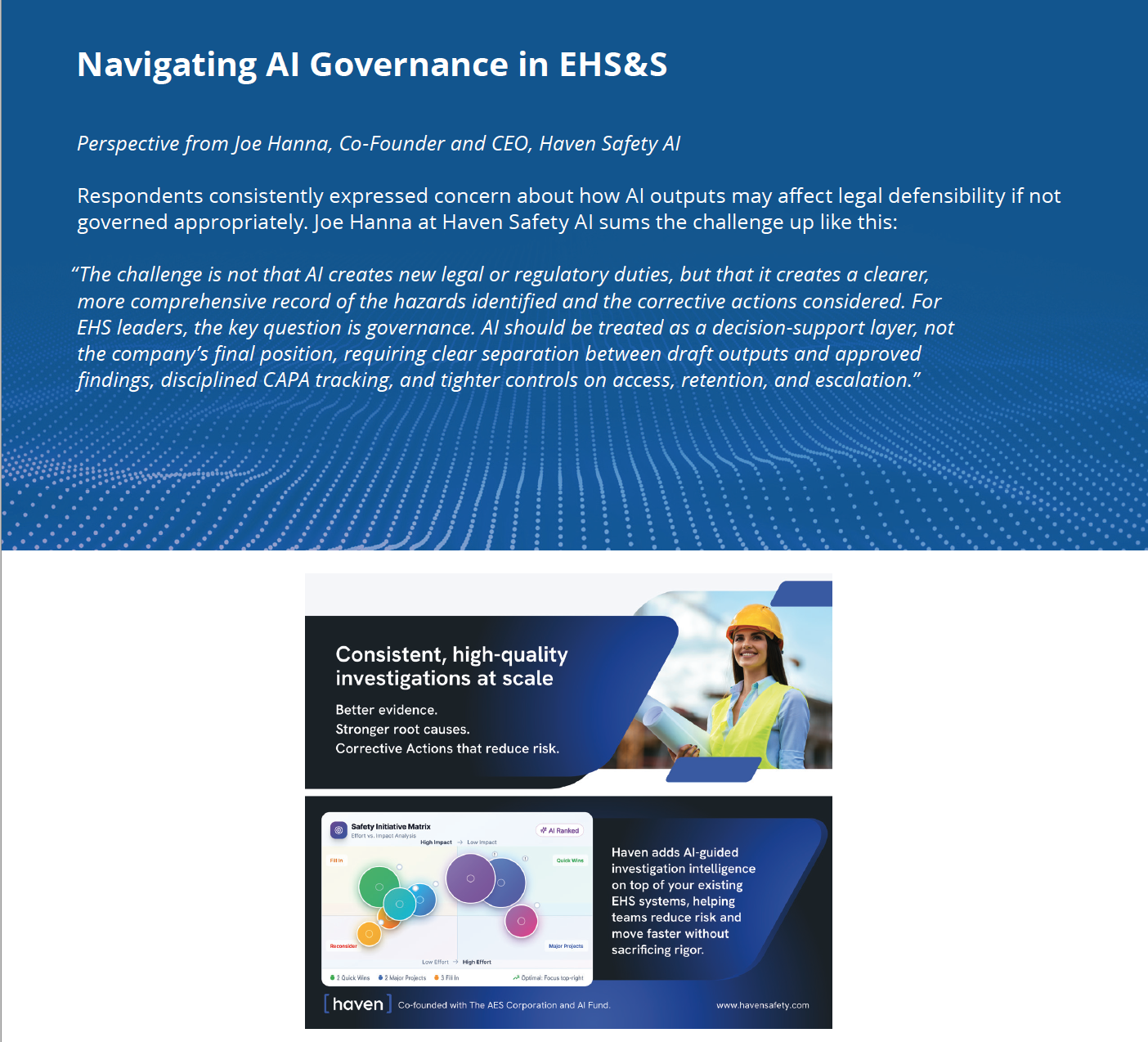
Respondents consistently expressed concern about how AI outputs may affect legal defensibility if not governed appropriately. Joe Hanna at Haven Safety AI sums the challenge up like this:
"The challenge is not that AI creates new legal or regulatory duties, but that it creates a clearer, more comprehensive record of the hazards identified and the corrective actions considered. For EHS leaders, the key question is governance. AI should be treated as a decision-support layer, not the company's final position, requiring clear separation between draft outputs and approved findings, disciplined CAPA tracking, and tighter controls on access, retention, and escalation."
A related challenge is the need for executive leadership support. Respondents highlighted that meaningful AI adoption often exceeds the scope of departmental experimentation and requires cross-functional alignment and sustained resourcing. One respondent from a chemical manufacturing company cautioned, "Due to the scale of impact, it needs full leadership support and resourcing. I would not undertake this as a departmental objective."
Finally, data validation and output quality remain persistent concerns. Even where AI delivers efficiency, respondents caution that inaccuracies can erode value if results are not carefully reviewed. A respondent from a retail and wholesale trade company commented, "Incorrect information from AI that is not checked by staff is a real concern. The time needed to validate results can offset the benefits if we're not careful." Another respondent echoed this experience, noting, "Inaccuracies are abundant and not always caught when large data or documents are being reviewed. The time required to validate the results often eliminates the efficiency gains." Others pointed out domain specific limitations, explaining that "AI struggles to apply regulatory requirements to our specific processes. A lot of confirming of regulatory references is still required."
Roadmap to AI Readiness
Preparing for More Sophisticated AI Adoption
Survey responses indicate that organizations are taking a deliberate, foundation-focused approach to preparing for more sophisticated AI adoption. Rather than deploying advanced applications immediately, most efforts center on strengthening workforce capabilities, modernizing systems, improving data quality, and establishing governance structures.
Figure 9 — Steps Taken to Prepare for More Sophisticated AI Adoption
- Trained staff on AI fundamentals: 54%
- Upgraded software systems to support AI capabilities: 39%
- Implemented new data governance or quality standards: 37%
- Developed an AI governance or ethical use framework: 35%
- Communicated AI strategy to employees: 33%
- Enhanced cybersecurity controls: 30%
- Granted licenses to enterprise AI software tools: 29%
- Formed cross functional AI working groups: 29%
- Promoted successful early use cases: 27%
- Built internal data lakes or unified reporting platforms: 27%
- Hired data scientists or AI/analytics specialists: 25%
- Created AI experimentation groups: 20%
- Created an internal roadmap for AI adoption: 19%
- Updated digital transformation strategy to include AI: 19%
- Identified and mapped AI ready use cases: 19%
- Conducted AI related risk assessments: 19%
- Developed a responsible AI framework and governance model: 18%
- Reviewed regulatory implications of AI use: 18%
- Did not take any specific steps: 13%
- Partnered with external consultants or technology vendors: 13%
- Upskilled EHS/Sustainability teams on analytics tools: 13%
- Centralized or cleaned EHS/Sustainability data: 13%
- Evaluated vendor AI solutions through proof of concepts: 11%
- Established KPIs to measure AI impact: 9%
- Other (please specify): 8%
- Piloted AI tools for incident prediction, risk modeling, or environmental monitoring: 6%
- Conducted a data readiness assessment: 6%
- Ran change management or awareness initiatives: 4%
- Integrated IoT sensors or real time monitoring technologies: 4%
The most frequently cited readiness step is training staff on AI fundamentals. Organizations report investing in basic AI literacy so EHS&S teams can understand how AI tools function, how to use them effectively, and where limitations exist. This foundational knowledge helps teams engage with AI more productively and evaluate outputs with appropriate caution. As one respondent noted, "A need for basic 101 prompt training, having this from an EHS&S perspective would accelerate usage and breakthrough ideas."
Another common focus area is upgrading software systems to support AI capabilities. Many organizations report that existing EHS, ESG, or enterprise systems must be modernized before AI can be meaningfully integrated into workflows. System upgrades improve interoperability and enable AI-assisted features that are increasingly embedded within commercial software platforms. One respondent identified a need for "Upgraded software systems to support AI capabilities so we could begin integrating AI into our existing EHS workflows."
Respondents also consistently point to the importance of data governance and data quality standards as a prerequisite for scaling AI use. Establishing clear rules around data security, access, quality, and appropriate use helps reduce risk and build organizational confidence in AI outputs. Without these controls, organizations are hesitant to rely on AI for more sensitive or regulated activities. As one respondent observed, "Data security is key and recognized within EHS decision makers; this is the first hurdle to overcome. There still seems to be missing governance around when and how AI should be used."
Closely related to governance efforts are steps to centralize and clean EHS and Sustainability data. AI readiness frequently exposes underlying data challenges, prompting organizations to focus on consolidating fragmented datasets and improving consistency before attempting more advanced analytics or automation. One respondent emphasized this point, stating, "Establishing a strong data foundation by structuring and standardizing EHS data was necessary before we could trust AI outputs."
Finally, many organizations are formalizing access to AI through enterprise approved tools rather than relying on individual or unofficial usage. While this step was widely selected in the survey, respondents did not provide direct commentary describing this decision in their own words. This suggests that access enablement is often handled through IT or enterprise programs rather than EHS led initiatives.
Risks of General-Purpose AI in High Consequence EHS&S
Perspective from Dr. Julia Penfield, Chief AI Officer, VelocityEHS, and Marc Juaire, Senior Director, Head of Product, Safety
As artificial intelligence becomes more widely available, EHS&S leaders are encountering a growing number of general purpose AI tools that were not designed for safety critical environments. Dr. Julia Penfield cautions that this trend introduces significant risk when AI is applied to high consequence decisions, particularly those involving serious injury and fatality (SIF). "The EHS space is polluted with off-the-shelf models that are not developed for sensitive safety applications," she noted, adding that "more and more vendors, without precautions, benchmarking, or proper evaluation, are giving safety advice with no risk mitigation measures in place."
Unlike purpose-built systems, generic generative AI models are not optimized to minimize errors in specialized safety contexts. These models are typically trained on broad, uncurated data and may not account for known failure modes, such as hallucinations or misuse. As Dr. Penfield explained, "General, non-purpose-built models, especially those that do not train for mistakes or minimize hallucinations for particular measures, present a more prevalent risk." She emphasized the potential downstream consequences, observing that "if AI follows data from an API call and a customer then follows its instructions and a SIF occurs, it will dramatically impact how well we can incorporate AI in the EHS&S space."
Marc Juaire, Head of Product, Safety at VelocityEHS put a fine point on the risk of the misapplication of this powerful technology, noting "It's not a matter of if, it's a matter of when."
Key Takeaways
Respondents identified several steps needed to build a successful program. Collectively, they indicate that most organizations are still building the conditions necessary for responsible AI adoption, with emphasis on workforce readiness, data reliability, governance, and system capability. This foundation-first approach mirrors patterns NAEM has observed with prior waves of EHS&S technology adoption, where early success depends less on advanced tools and more on organizational preparedness.
Partnerships Create Progress
Qualitative interviews showed that third-party software partners are critical for more advanced AI functions. Chet Brandon, Sr. Director of Global EHS at Hexion, discussed a seven-year partnership with his software provider that allowed him to leverage computer vision for unsafe behaviors and sensitive dataset analytics. Another EHS leader shared how software providers can help users leverage AI to assist with identifying high-risk confined spaces in real time: "There is no need to go at it alone, advanced AI requires real partnerships."
Amanda Smith, Executive Vice President of Strategy at Cority, also highlighted the need for connecting systems: "For higher usage and ultimate AI value add, you need connected data that isn't siloed. AI makes it possible to see connections between data sources that humans otherwise wouldn't see. But AI can also help you better capture data in the first place."
Appendix A – AI Maturity Levels
Definition of the Seven Levels of AI Maturity in EHS&S
To assess how organizations are using artificial intelligence in EHS and Sustainability, this research organizes AI activities into seven levels of maturity. The levels are defined by how AI is applied, how formal its use is, and how deeply it is integrated into EHS&S systems and decision-making. Progression through the levels reflects increasing organizational confidence, governance, and operational integration, not simply more technology.
Level 1 — Background Research Only At this level, AI is used informally by individuals to support general research or editing in day-to-day work. Use is occasional, unofficial, and not connected to core EHS or sustainability activities. AI is not integrated with internal EHS, ESG, or operational data.
Typical uses include searching for information, checking accuracy, and editing basic documents or emails. While this level reflects early exposure to AI tools, it does not materially change how EHS&S programs operate.
Level 2 — Basic Content Creation Organizations at this level use AI to generate limited content related to EHS&S topics, still on an informal and individual basis. AI use remains outside official workflows and does not involve integration with internal systems or data.
Common applications include drafting policies, procedures, or training materials; summarizing regulations or guidance; brainstorming sustainability initiatives; and transposing information from documents into templates or forms. The primary value at this stage is efficiency in content creation rather than operational insight.
Level 3 — Early/Task Automation At Level 3, AI begins to support discrete, low-risk EHS and Sustainability tasks. Use is becoming more intentional and extends beyond purely individual experimentation, though it is often still limited in scope.
AI may be used to automate incident report summaries, audit or inspection write-ups, corrective action descriptions, document classification and tagging, or data extraction from PDFs, permits, SDSs, or reports. Basic internal chatbots and scheduled prompts may also appear. While governance is still developing, AI use at this level starts to touch core EHS processes.
Level 4 — Operational/Embedded in Workflows Organizations reaching this level have integrated AI into formal EHS and Sustainability systems and workflows. AI use is intentional, team-based, and part of regular operations rather than isolated tasks.
Examples include AI-assisted ESG or sustainability reporting, automated data validation and anomaly detection, generation of insights from incident and audit data, predictive analytics for injury risk or compliance gaps, and AI-assisted root cause analysis. At this stage, AI supports operational decisions but typically includes strong human review and oversight.
Level 5 — Advanced/Decision-Support At Level 5, AI goes beyond efficiency and insight generation to actively support decision-making. Models and outputs are used to prioritize actions, allocate resources, and guide risk management strategies.
Common applications include predictive models for serious injury and fatality (SIF) risk or environmental incidents, AI-driven prioritization of inspections and audits, computer vision for PPE compliance and unsafe behavior detection, and scenario modeling for sustainability strategies. While decisions remain human owned, AI materially influences outcomes.
Level 6 — Scaled & Governed Organizations at this level trust AI for regulated, enterprise-wide use. Formal governance structures, controls, and accountability mechanisms are in place to manage legal, regulatory, and operational risk.
Typical uses include AI-supported regulatory submissions (with defined controls), scaled Scope 3 emissions estimation and supplier risk screening, automated compliance monitoring across jurisdictions, AI-enabled benchmarking and performance forecasting, and integrated EHS–ESG–operations analytics. AI use is consistent, auditable, and aligned with organizational governance expectations.
Level 7 — Innovative At the highest level of maturity, AI is treated as a strategic capability, not a standalone tool. AI systems continuously learn, adapt, and support proactive risk management and design decisions.
Applications may include real-time risk sensing through IoT and AI, autonomous hazard identification and alerts, digital twins of facilities, environmental impacts, or safety scenarios, and AI-driven design of safer processes or lower-impact operations. These systems improve over time based on outcomes and feedback, enabling continuous learning and innovation.
Contributors
NAEM extends its sincere appreciation to the following individuals for generously contributing their time, insights, and professional expertise to this research. Their perspectives helped inform both the quantitative and qualitative findings presented throughout this report and provided valuable context on how artificial intelligence is being explored and applied within EHS and Sustainability functions.
The contributors listed below participated in interviews and discussions that enhanced NAEM's understanding of current practices, challenges, and considerations related to AI adoption. Their contributions reflect personal insights and experiences and do not imply endorsement of the findings or conclusions contained in this report.
- Bhaumik Amin, FN
- Chet Brandon, Hexion
- Jen Criqui, Veralto
- Joe Hanna, Haven Safety AI
- Rod Hildebrand, TRC Companies
- Jeff Jones, Exact Sciences
- Marc Juaire, VelocityEHS
- Dr. Julia Penfield, VelocityEHS
- Maria Rutland, 3E
- Kelvin Sanborne, GE Healthcare
- Laurie Townsend-Sanders, GE Healthcare
- Amanda Smith, Cority
- Allen Stegman, BNSF
- Bradley Wilson, Arcadis
Additional NAEM Research
EHS & Sustainability Staffing, Structure & Budget Report (2024) This report is the only research designed by and for corporate EHS&S leaders to provide valuable insight into how your organization compares by industry, revenue, headcount and operational risk. Download the report today at: naem.org/ssb
2023 EHS & Sustainability Salary Report In partnership with EHSCareers, NAEM presents results from the 2023 EHS&S Salary Survey, featuring detailed analyses of how compensation is affected by education, certifications, career stage, and industry. Download the report today at: naem.org/what-we-offer/research/reports/read/2023-ehs-sustainability-salary-report
The Emergence of Virtual EHS Audits COVID-19 presented unprecedented challenges to EHS auditing programs. With widespread social distancing requirements and travel restrictions, EHS leaders had to rapidly adapt their programs in order to continue to effectively manage risk. The Emergence of Virtual EHS Audits report offers a first look at how leading companies are executing virtual audits. Download the report today at: naem.org/what-we-offer/research/reports/read/the-emergence-of-virtual-ehs-audits
Sustainability in the New Normal: A 2020 Benchmark Take a look behind the scenes at the effects of unprecedented challenges, a deep economic recession, COVID-19's long-term impacts and social unrest, on corporate sustainability. Download the report today at: naem.org/what-we-offer/research/reports/read/benchmarking-corporate-sustainability-priorities-covid-19
How COVID-19 is Impacting the EHS Function: The First Industry Benchmark Wondering how other companies have reacted to COVID-19 and how it has impacted their EHS operations? NAEM recently conducted the first industry benchmark on how companies managed the initial response to the global pandemic. Download the free report for a full analysis of how EHS functions have been affected by COVID-19. Download the report today at: naem.org/what-we-offer/research/reports/read/covid-19-ehs
EHS & Sustainability Staffing Structure & Budget Report Are you trying to benchmark the size and reporting structure of your EHS & Sustainability (EHS&S) function? This comprehensive benchmark report offers an analysis of the organizational design, reporting structure, staffing levels and budgets of EHS&S functions from 150 companies across more than a dozen different industry sectors. Download the report today at: naem.org/what-we-offer/research/reports/read/ehs-sustainability-staffing-structure-budgets-benchmark-2020
Share: