AES operates complex utility and renewable energy environments where safety investigations carry operational, regulatory, and human consequences. AES rollout of Haven across U.S. operations is one of the energy sector’s first large-scale implementations of an AI-native safety platform, built to investigate incidents faster, uncover systemic risk earlier, and help prevent serious injuries before they occur.
AES operates complex utility and renewable energy environments where safety investigations carry operational, regulatory, and human consequences. AES rollout of Haven across U.S. operations is one of the energy sector's first large-scale implementations of an AI-native safety platform, built to investigate incidents faster, uncover systemic risk earlier, and help prevent serious injuries before they occur.
Across EHS, AI adoption is moving from experimentation into applied workflows. ASSP says AI adoption in EHS is underway, with early adopters already using AI tools to analyze incident data and streamline safety reporting.
Despite decades of progress in compliance, AES faced a structural constraint common across the industry: investigations were manual, time-intensive, and difficult to scale, limiting the organization's ability to extract system-wide insights and act proactively.
Traditional workflows required:
- Extensive manual data gathering across fragmented sources
- Significant investigator time spent on documentation rather than field engagement
- Limited ability to detect repeat or systemic risks across sites
As a result, even though root cause analysis (RCA) is highly effective for preventing serious incidents, it remained resource-constrained and underscaled. Before Haven, investigations depended on fragmented notes, interviews, reports, procedures, emails, and other unstructured inputs. The company viewed RCA as highly effective for preventing severe incidents, but difficult to expand because the process was so labor intensive.
The opportunity was to turn scattered evidence into faster, more consistent, evidence-based learning across sites.
The Turning Point: Embedding AI into the Investigation Workflow
AES implemented HavenSIGHT and HavenEDGE to do exactly that. HavenSIGHT structures frontline evidence by guiding witness interviews, ingesting documents, photos, audio, and other inputs, extracting facts and conditions, reconstructing timelines, and flagging missing or inconsistent information before analysis begins.
HavenEDGE then takes that evidence and applies multi-threaded RCA, Five Whys, and fishbone analysis to surface causal pathways, explain why the event happened, and recommend corrective actions scored for effort and impact. In other words, Haven does not stop at recording an incident. It helps explain the event, analyze the underlying evidence, and translate findings into action.
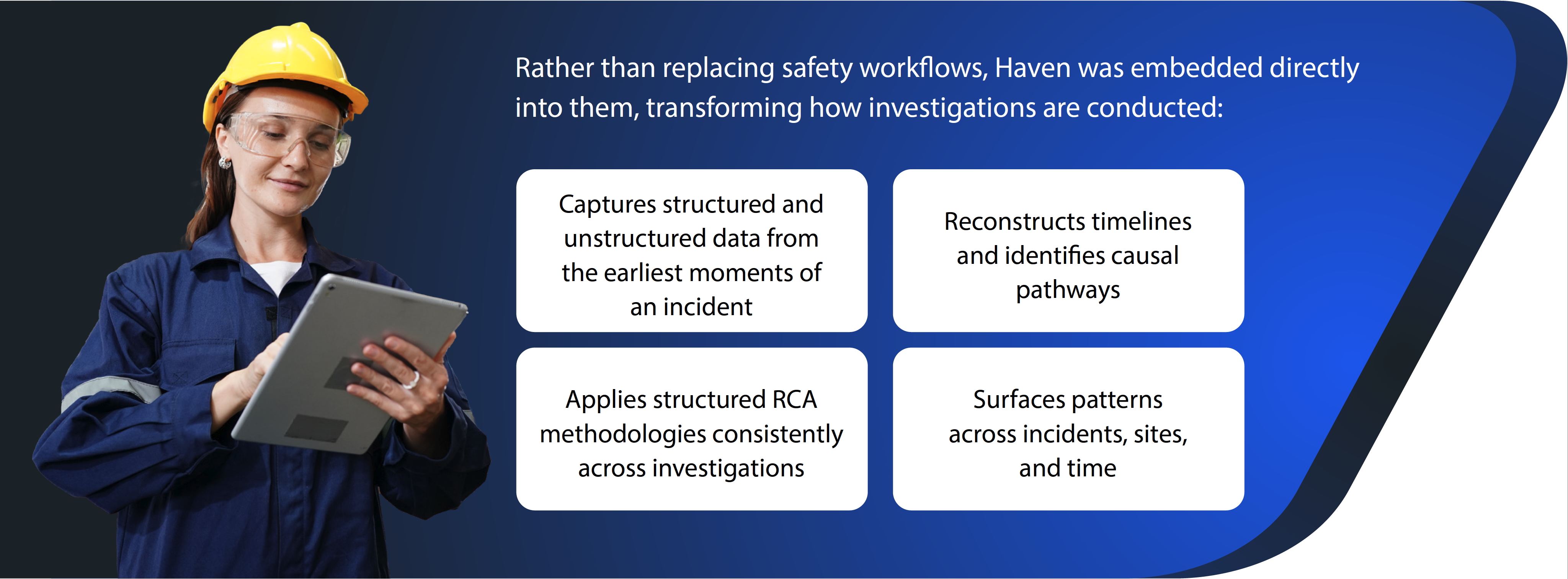
Rather than replacing safety workflows, Haven was embedded directly into them, transforming how investigations are conducted:
- Captures structured and unstructured data from the earliest moments of an incident
- Reconstructs timelines and identifies causal pathways
- Applies structured RCA methodologies consistently across investigations
- Surfaces patterns across incidents, sites, and time
Instead of spending time compiling reports behind a desk, our teams can now focus on understanding risk on site
— Chantz Horman, Director of US Operations and Construction Health & Safety, AES
Outcomes, Scale, and Strategic Value
The implementation achieved three main outcomes: less investigation effort, broader analytical coverage, and better preventive insight. AES reported a 50% reduction in RCA investigation labor time and said it expects to double the number of RCAs completed in the year, while freeing safety professionals to spend less time in documentation and more time in the field. In related public materials, AES also pointed to improved root cause consistency and stronger visibility into repeat and systemic risks across sites.
That improvement is not just about efficiency. It reflects a different kind of investigation workflow. HavenSIGHT converts raw evidence into structured, investigation-ready inputs, including clean narratives and validated timelines. HavenEDGE builds on that foundation with evidence-anchored causal analysis, knowledge-graph-assisted reasoning, and corrective actions tied back to source logic. The outputs are traceable to source evidence and suitable for internal review, auditors, regulators, and insurers. That is the difference between a faster reporting tool and a safety intelligence system that can support defensible decisions.
This allows our teams to spend their valuable time closer to our operations where they are invaluable
— Evaristo Leonardi, AES Utilities Chief Operations Officer
Most tools stop at reporting, while real prevention requires a loop of capture, analysis, action, and verification. HavenSIGHT captures frontline observations, witness statements, and visual or documentary evidence. HavenEDGE analyzes incidents, surfaces causal patterns, and recommends corrective actions. For a company like AES, that means moving from isolated incident files to a system that can learn across events and sites.
As Chris Shelton, AES Chief Product Officer and President, AES Next, put it, Haven helps teams "quickly digest more insights than traditional tools." In the AES context, that is the real success story: not simply digitizing investigations, but giving safety teams a way to understand incidents more completely, connect evidence to cause, and act on systemic risk sooner.
Conclusion
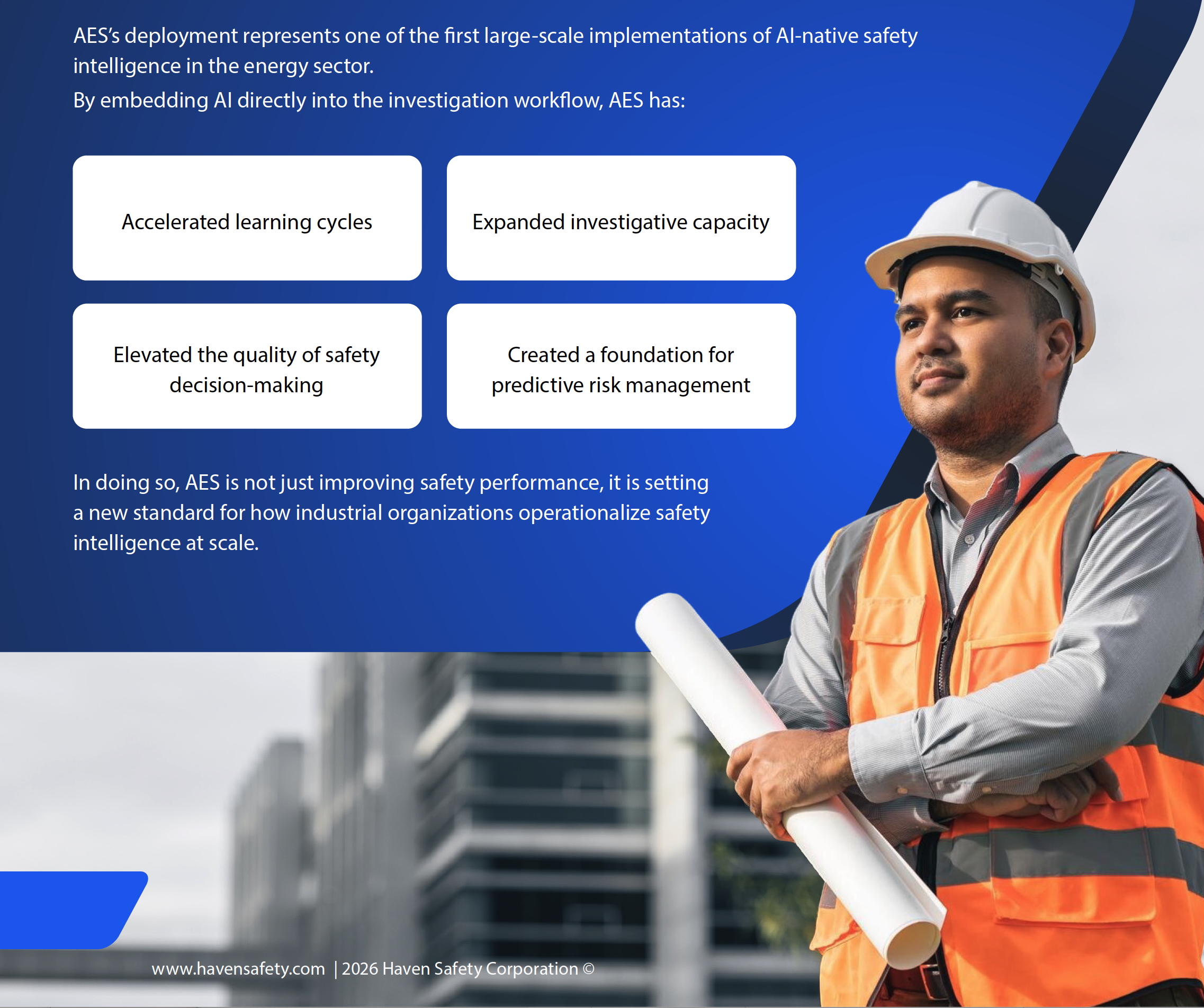
AES's deployment represents one of the first large-scale implementations of AI-native safety intelligence in the energy sector. By embedding AI directly into the investigation workflow, AES has:
- Accelerated learning cycles
- Expanded investigative capacity
- Elevated the quality of safety decision-making
- Created a foundation for predictive risk management
In doing so, AES is not just improving safety performance, it is setting a new standard for how industrial organizations operationalize safety intelligence at scale.
Share: